Crowdsourced abuse: Technology-Facilitated Gender-Based Violence
During the second day of the POINT 14 Conference, special attention was paid to online gender-based violence issues.

Moderated by Tijana Cvjetićanin, Program Director of CA “Why not”, the session “Crowdsourced abuse: Technology-Facilitated Gender-Based Violence” covered various topics that range from non-consensual or synthetic pornography to very disturbing phenomenon known as rape academies. As Cvjetićanin explained, it is titled “crowdsourcing” because many cases involve collective action from mostly men, that is designed to intimidate, humiliate, harass or sexually exploit mostly women and, in some cases, girls. Each participant of the panel spoke from a particular angle on this very important topic.

Nikolina Tomašević, one of the founders of “OsnaŽene”, an organization dedicated to gender equality, digital security, human rights, and support for women and young people, presented research conducted by the association. Findings from 2024 undercovered over 40 Telegram groups across the Balkans engaged in sharing, searching for, and commenting on intimate and sexualized content featuring women and girls.
“We started this research after a few girls messaged us on Instagram, saying their photos were shared in Telegram groups without their consent. We decided to join some of these groups ourselves, so we could understand what is actually going on inside,” Tomašević explained, noting that one group even had 70,000 members.
“This number is important because it shows us that this is the massive ecosystem of gender-based violence, not just a few isolated abusers. It’s always about pressure, control and power,” Tomašević said, warning this can have real-life consequences.

The findings also show that the content shared in these groups included different kinds and forms of abuse, with very disturbing cases where the male family members secretly photographed and filmed women in their own families, including mothers, sisters and other female relatives, showing the abuse was occurring in places where women should usually feel safe – in their own homes. Some of the content found in these groups included minors.
Azem Kurtić, BIRN’s Bosnia and Herzegovina correspondent for Balkan Insight, presented a database that tracks digital rights violations in the region, including gender-based violence. The program includes the Balkans and Turkey. As Kurtić noted, the base contains thousands and thousands of different cases that can be searched by country or by different types of violations. The cases ranged from female journalists being targeted by doxing or even organized campaigns, to more serious cases of revenge pornography or AI-generated non-consensual pornography. While the monitoring process was similar in countries involved, it also showed distinctive features for each country.
“When you think about digital rights, you have to think about the fact that digital rights are human rights, and that any violation that occurs in real life can also occur in the online world,” Kurtić warned.
Miljana Čabrilovski, anthropologist and researcher from Roma Feminist Collective from Serbia, spoke about “multi-layered” mapping research revolving around intersection between gender-based violence and discrimination of Roma women and girls as members of minority groups. The research, conducted by her colleagues and her, highlights that, while one in three women worldwide experiences some form of violence during their lifetime, according to WHO, Roma women face disproportionately higher risks due to the combined effects of gender, ethnicity, and socio-economic factors. The findings show that discrimination and violence against Roma women are not isolated incidents but part of broader marginalization. In this term, technology-facilitated gender-based violence should be understood as a manifestation of broader social inequalities.
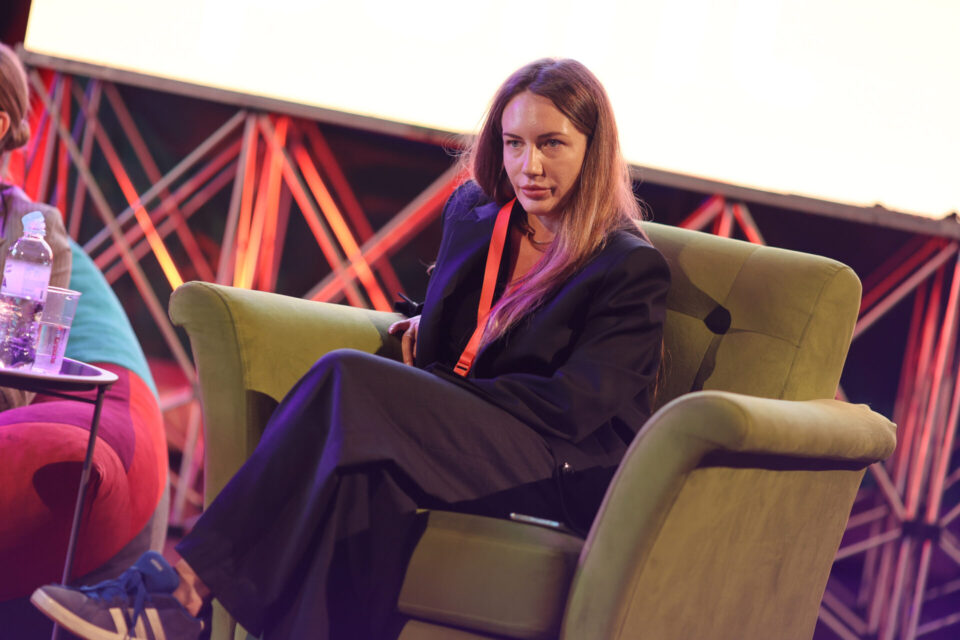
Jelena Kalinić, climate and health journalist, scientific communicator and founder of “Nauka i svijet”, highlighted that technology-facilitated sexual harassment is a phenomenon that already existed, roothed in patriarchy, but it is now more visible and stronger than ever, “like misogyny on steroids”.
“It is easier than ever to make these ‘fake nudes’. We have technology that exists just for that and all the patterns that we see in patriarchy and in misogynistic behavior are now transformed into digital technologies,” said Kalinić.
Speaking about a phenomenon called the “manosphere”, she said it’s a community of men who see women as property – as something to be undressed, used, and offered to others, especially in Balkan societies. She paid special attention to AI applications designed to generate non-consensual intimate photos, noting that these tools can also disrupt young people’s perceptions of the body and sexuality, affecting their mental health.
Speakers agreed that combating technology-facilitated gender-based violence requires stronger law enforcement, clearer accountability of major online platforms, better support and understanding for victims, and stronger digital literacy. One of the speakers pointed out that popular culture is also a very powerful tool for raising awareness, such as the Netflix TV show “Adolescence”, which examines the dangers of the online world and the toxic influence of the manosphere.
Author: Aldijana Handžar Zorlak / Photo: Almin Tabak
(point.zastone.ba)