Moldova after the Elections: The Aftermath, Social Cohesion and a Whole-of-Society Response
In the morning of the first day of the 14th Point conference, the amphitheater in Dom mladih hosted a panel titled “Moldova after the Elections: The Aftermath, Social Cohesion, and a Whole-of-Society Response”.
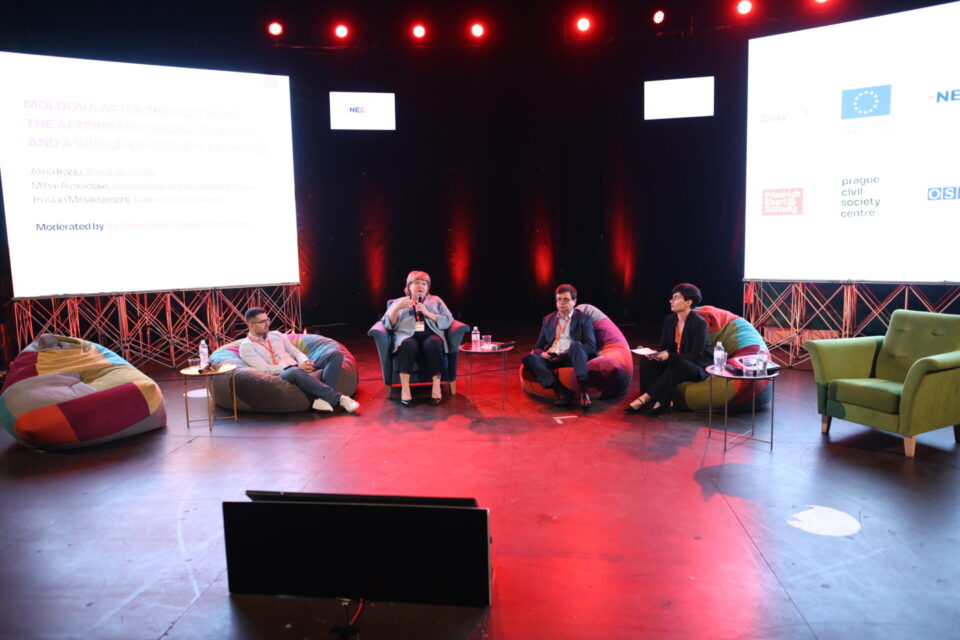
The panel was moderated by Open Information Partnership and it brought together Alina Radu, investigative reporter from Ziarul de Gardă (ZdG), the largest investigative platform in Moldova, Mihai Avasiloaie, editor-in-chief of Moldovan fact-checking Stopfals and Ruslan Mihalevschi, regulator in the Audio-visual Council of Moldova to discuss the aftermath and combating of foreign-information manipulation (FIMI) and disinformation prior to the elections.
Alina Radu shared details about an investigative story that ZdG won the European Press Prize, and that investigated Russia’s illegal financing of digital and offline armies to organize protests and corrupt voting in elections. She described how they encountered strange events prior to the election and sent an undercover reporter into groups that were organizing strange protests and spreading disinformation. What they uncovered was that groups of people would be paid by Russia to spread specific, pre-determined fearmongering disinformation about the European Union and Moldovan public institutions, such as that, if Moldova enters the EU children will be forced to have sex in schools, churches will be forcibly closed and so on. This campaign had an impact on a portion of society, she said.
“The main conclusion is: when someone comes with money and fears, it might work. But then, the worst part is, how can you bring back to normality those people who were already poisoned? It’s a very difficult job”, said Radu.
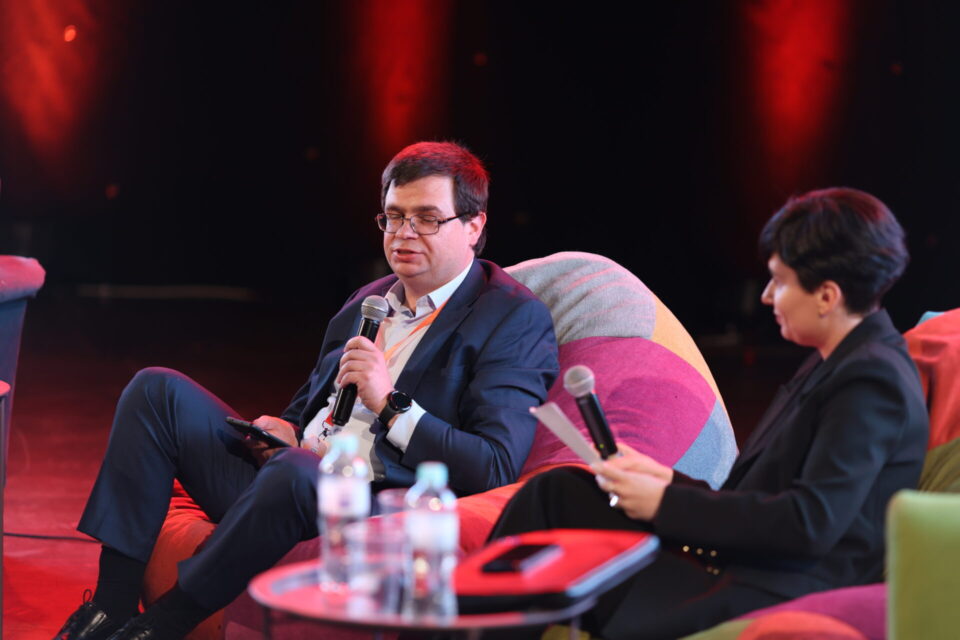
Talking about how Moldova deals with FIMI and other disinformation, Ruslan Mihalevschi said that there is no “silver bullet”. One of the most important lessons learned through the example of Moldovan elections was the significance of a combined effort between media, civil society, public institutions and the EU. He also described how the role of regulators has evolved with the media landscape, from traditionally giving out licenses for electronic broadcasters, to now being a part of the resilience and protection of media space.
Mihai Avasiloaie spoke about gaps that make the population or a country more vulnerable to FIMI and how to resist it. He noted that Moldova has weak social unity. Some people, he explained, simply don’t want to seek out different opinions and information and are more comfortable with holding beliefs they have been taught since childhood. The best way to build resilience is for all parts of society to do their jobs efficiently and that includes the media, civil society and public institutions.
“Everything comes up to the thing that everybody has to do an efficiently his or hers job. Journalists have to provide qualitative information, authorities need to have efficient communication, regulation and actions, NGOs as well can help in developing media literacy level because there is huge need for that. So, I think if everybody will do their job in the perspective of time, things will sort out”, he explained.
Speaking on the whole of society approach, Alina Radu noted that saving democracy, human rights and election integrity is an incredibly hard job being done by very dedicated people and if there is a lesson to be learned from Moldova, it is that it’s crucial to support them.
Ruslan Mihalevschi agreed:
“There are no short-term solutions. Long-term solutions are media literacy, I think it’s strongly necessary to promote local languages like Ukrainian language, Bulgarian language, not only Russian language. It’s important to start with education, it’s important to promote and to help to create local high quality journalistic content in local languages and, once again, to find the possibility to invest in government communication”, Ruslan said.
Author: Nerma Šehović-Kašić / Photo: Almin Tabak
(point.zastone.ba)