When Activists and AI Know Better Than Your Government: Wounded Balkan Land Shaped by Quarrying
A panel discussion at the 14th POINT Conference examined how illegal and poorly regulated quarrying is reshaping landscapes across the Western Balkans, exposing institutional failures, threatening local communities, and pushing journalists and activists to use new tools in order to uncover what governments often fail to map or regulate.
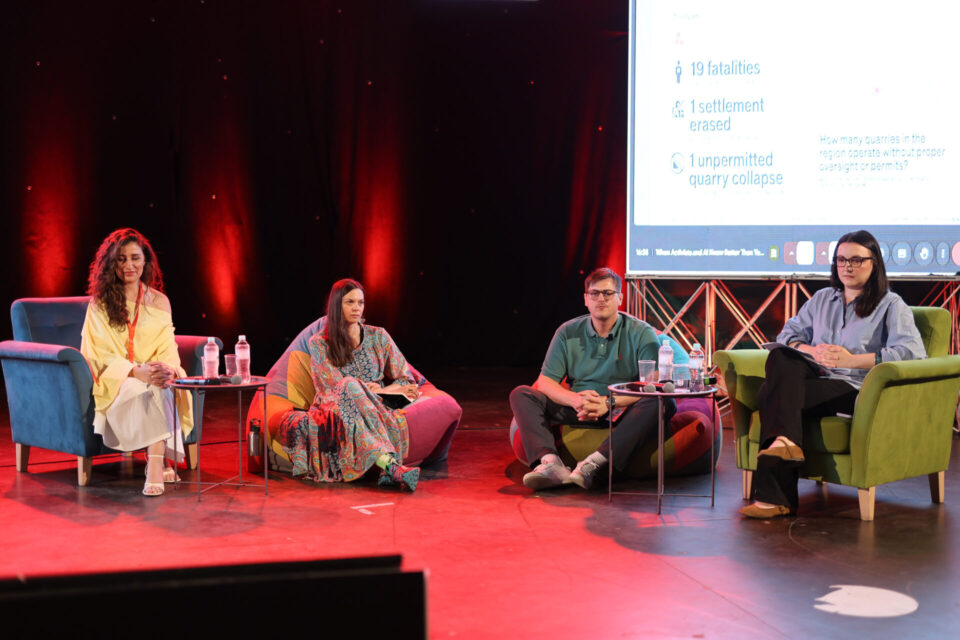
The panel “When Activists and AI Know Better Than Your Government: Wounded Balkan Land Shaped by Quarrying” was moderated by Nikola Bačić, investigative journalist and editor-in-chief of Hercegovina.info. The discussion brought together Miloš Katić from Radio Free Europe/Radio Liberty’s digital forensic team, Meliha Kešmer from Radio Free Europe/Radio Liberty Bosnia and Herzegovina, Edina Osmanović, environmental activist from Montenegro and Young European Ambassador, and Lejla Kusturica, activist and director of the ACT Foundation – Atelier for Community Transformation.
Opening the discussion, Bačić recalled the tragedy in Donja Jablanica, where 19 people lost their lives in the floods of October 2024. He noted that an illegal quarry was identified as one of the factors connected to the scale of the disaster, while questions of responsibility remain unresolved. The case, he said, revealed not only the danger of unregulated extraction, but also the depth of institutional silence surrounding such sites.
Presenting the regional investigation conducted by Radio Free Europe/Radio Liberty, Miloš Katić explained how the tragedy in Jablanica became the starting point for a broader inquiry into quarrying across the Western Balkans. The team began with a simple question: how many similar locations exist across the region without citizens being aware of the risks they pose?
What started as an idea to examine one country quickly expanded into a regional investigation. Katić explained that the first challenge was collecting information on legal quarries and concession areas. While some countries had digital records, others provided incomplete, outdated or unusable documentation. In North Macedonia and Montenegro, the team received hardcopy documents, often with incorrect coordinates or different coordinate systems. Bosnia and Herzegovina proved to be the most complicated case because of fragmented institutional responsibilities and the lack of centralized data.
To process the information, the team combined official records, artificial intelligence, satellite imagery and field verification. Katić explained that tools such as Earth Index helped identify potential quarry locations from satellite images, while ChatGPT was used to assist in converting hardcopy documents into digital formats. However, he stressed that the team did not treat AI-generated results as final evidence.
“AI is fast, but it can be wrong,” Katić said, adding that public records, although official, “can be outdated, incomplete or practically unusable.”
The investigation therefore relied on a multilayered methodology. Potential quarry locations were compared with official concession areas and permits. The team then used Google Earth, Planet Labs, Mapillary, Street View, local sources, NGOs and, where necessary, field visits. Katić said that satellite images can reveal visible damage, but they cannot explain the full story.
“Satellite images can show the scar, but people on the ground can explain the real situation there,” he said.
The results were striking. Across five countries, the investigation identified around 1,350 quarry sites. More than 600 were operating illegally, outside approved areas or outside available official records, while around 750 had some form of legal permit. For Katić, the main innovation was not one specific tool, but the workflow: combining official data, AI, satellite imagery, human verification and field evidence.
“When institutions fail to map reality, journalists can try to reconstruct it,” Katić concluded.
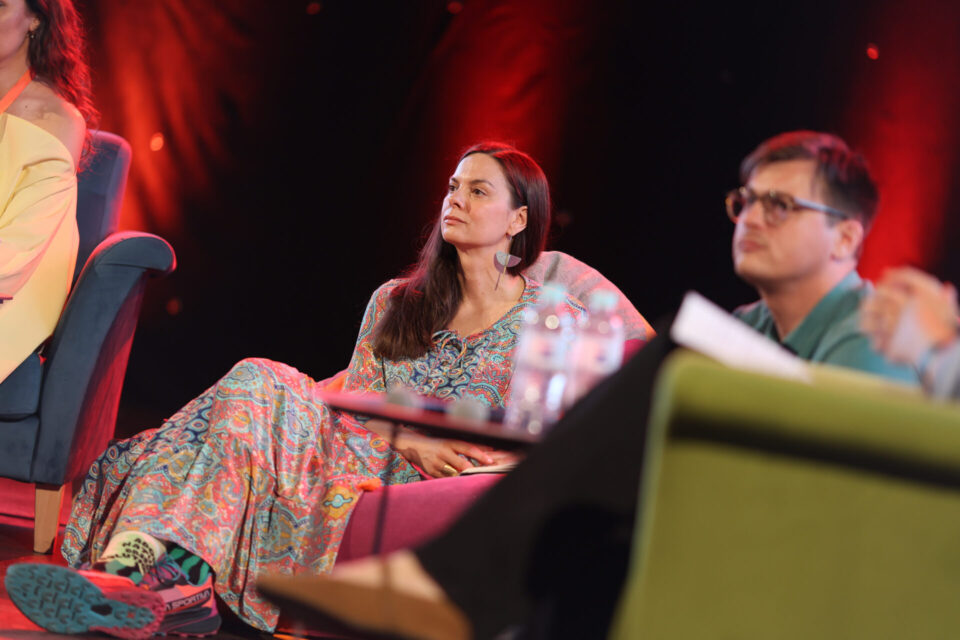
Meliha Kešmer focused on the situation in Bosnia and Herzegovina, describing the country as the most difficult part of the investigation. She explained that there is no central register of quarries and no single institution that can provide all relevant information on concessions, permits, environmental approvals and inspections. Responsibilities are divided between entities, cantons, ministries and municipalities, leaving journalists and citizens trapped in a system where no institution appears to have the full picture.
“In Bosnia, there is no central register for these things,” Kešmer said, explaining that one institution may issue one type of permit, another may be responsible for environmental approvals, while a third may be in charge of inspections.
Kešmer said that Republika Srpska provided more centralized information, while in the Federation of Bosnia and Herzegovina the team received partial data from the Herzegovina-Neretva Canton and the Federal Ministry of Economy. Other cantons did not provide answers despite repeated requests over several months.
According to Kešmer, this lack of transparency becomes most visible in cases such as Donja Jablanica. Activists and environmental groups had warned about the location before the tragedy, but institutions failed to act. Even after the loss of 19 lives, the investigation has not provided clear answers. She warned that if such difficulties exist in a case that attracted national, regional and international attention, the situation is likely even worse in places that never reach the media.
“If this is happening in a case where we lost 19 lives, then you have to ask yourself what is happening in some other location that we never heard of,” Kešmer said.
In Bosnia and Herzegovina, AI and satellite imagery identified 329 quarry locations. Around one third were confirmed to have some form of permit, while the remaining two thirds were left in a grey zone — not because journalists declared them illegal, but because institutions failed to provide enough information to determine their status.
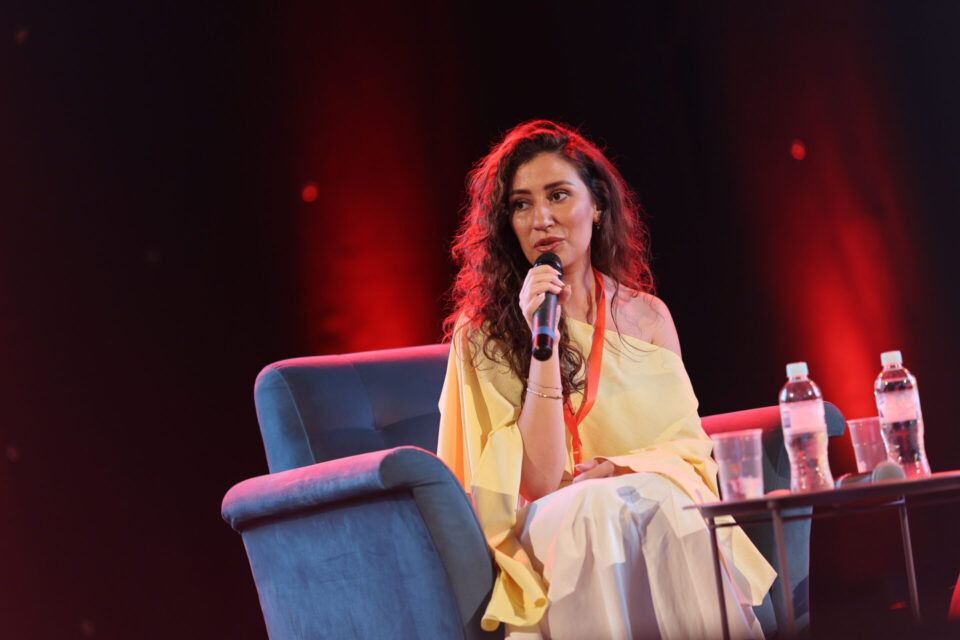
Bringing the perspective of local resistance, Edina Osmanović shared the story of Velja Gorana, a village near Bar in Montenegro, where a quarry was planned only about 200 meters from people’s homes. She started the fight against the project at the age of 22, after reading in the newspaper that a 30-year concession had been signed between the state and a private investor.
Osmanović described the struggle as a seven-year battle involving media pressure, legal action, community organizing and support from activists, journalists, lawyers and the diaspora. She said the case showed how investors often rely on political protection, pressure and attempts to isolate activists. Some people were offered apartments in exchange for land, while she faced hate speech, attempts to discredit her and efforts to pull her into political structures.
“We really have the power and we really can change things for the better,” Osmanović said, stressing that activists should not be underestimated.
Despite this, the activists won a first-instance court case proving that the process was illegal, although the case is still not fully over. Osmanović said the experience demonstrated that citizens can stop harmful projects when they organize early, persistently and collectively. She emphasized that local struggles can inspire other communities, noting that people from other villages in Montenegro later contacted her for advice and managed to stop similar projects in time.
“Whenever we are fighting for what is just, for what is right, it doesn’t matter if justice is slow,” she said. “It is actually possible.”
Lejla Kusturica placed the issue of quarrying within a broader regional and global context of extractivism. Speaking from the experience of ACT Foundation, which has supported dozens of grassroots environmental initiatives, she said communities across Bosnia and Herzegovina and the wider region often learn about harmful projects only after concession agreements have already been signed.
Kusturica warned that institutions frequently side with investors, even when laws and procedures exist to protect the public interest. She noted that the situation is becoming more dangerous because of the global demand for critical minerals such as lithium, cobalt and nickel, driven by the green transition. Large international corporations are increasingly interested in the region, while local institutions remain weak, fragmented and vulnerable to corruption.
She pointed to a lack of early citizen participation, weak concession frameworks, poor access to information and administrative silence as key problems. Even when public hearings are organized, institutions are often not obliged to meaningfully include comments from citizens or experts. In this environment, local communities are forced to defend rivers, forests and land through legal action, media campaigns and direct action.
Kusturica also highlighted the rise of regional solidarity among environmental activists. The movement that began as a struggle to defend rivers has expanded to forests, land, quarries and mining projects. Through the regional alliance “Let’s Defend the Nature of the Balkans,” more than 40 grassroots groups exchange knowledge, strategies and support.
For Kusturica, environmental struggles in the Western Balkans are not only about nature. They are also about democracy, institutional accountability and citizens’ right to decide what kind of development they want in their communities.
“This environmental struggle is basically the struggle to practice and build democracy,” Kusturica said.
The panel concluded with a message that technology can help reveal environmental damage, but it cannot replace journalists, activists and local communities. AI can identify possible scars in the landscape, satellite images can show the scale of extraction, and data can expose inconsistencies. But without people willing to verify, organize and confront institutions, the truth often remains buried.
Author: Dalio Sijah / Photo: Almin Tabak
(point.zastone.ba)